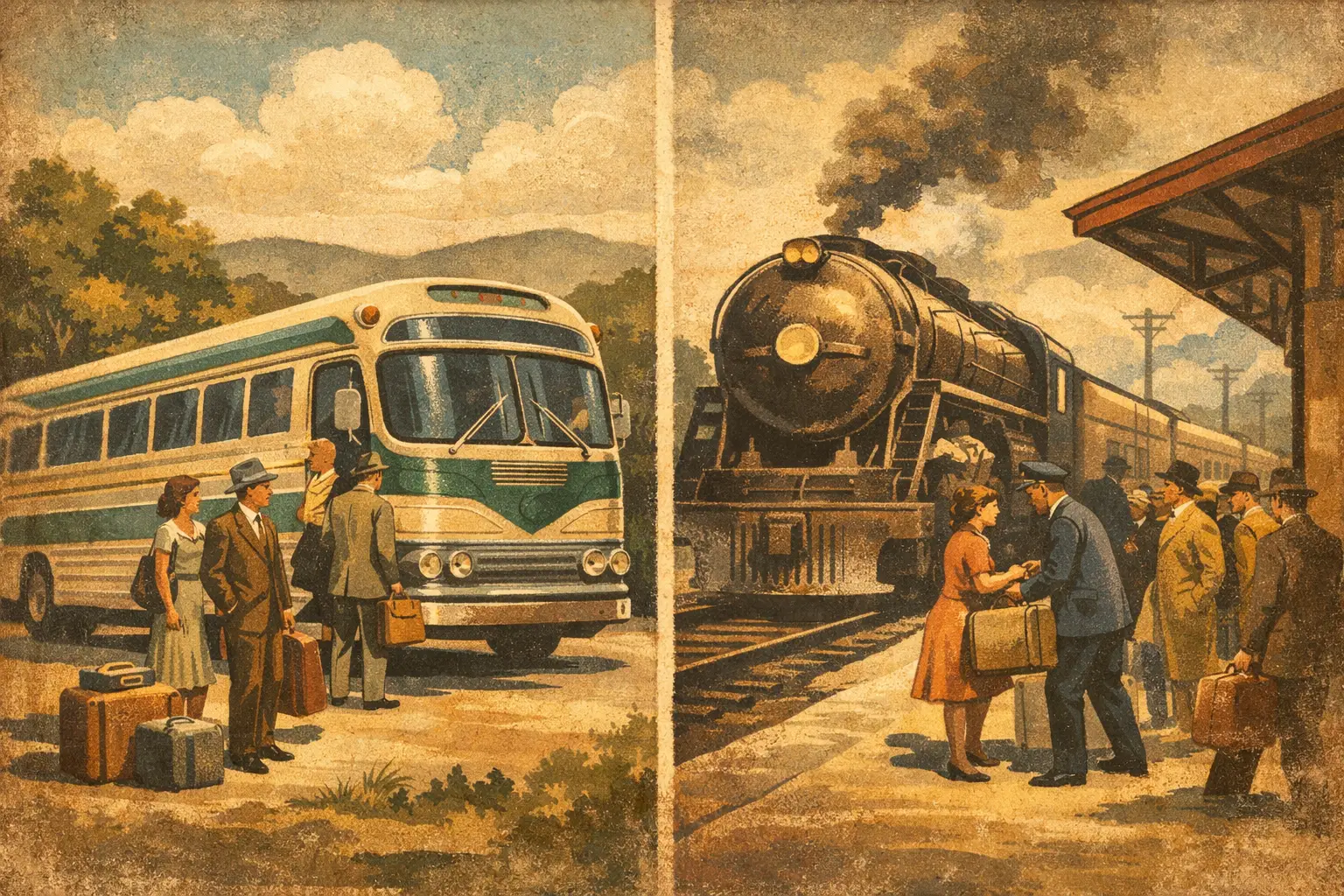
Miss a train departure by three minutes, and your whole itinerary can start sliding. For group planners, that is why the charter bus vs train decision is rarely just about transportation. It is about staying on schedule, keeping people together, and avoiding the kind of small delays that turn into bigger problems for weddings, corporate events, school trips, and private outings.
For some trips, train travel makes sense. It can be efficient, comfortable, and familiar, especially for smaller groups moving between major stations. But when the goal is controlled group logistics, a charter bus often gives planners more certainty. The right choice depends on where your group is going, how tight your schedule is, and how much flexibility you need once the trip begins.
Charter bus vs train: what matters most
The biggest difference between a charter bus and a train is control. With train travel, your group works around a public schedule, fixed station stops, and shared space. With a charter bus, the vehicle works around your itinerary.
That distinction matters more than many planners expect. A wedding shuttle has to arrive when guests need it, not when the next departure is available. A school group may need one vehicle, one driver, and one clear chain of accountability. A corporate team may need multiple pickups, an early departure, or a direct drop-off at a venue instead of a station several miles away.
If your trip is simple and station-to-station, the train may be a reasonable fit. If your trip involves coordination, timing, luggage, multiple stops, or a need to keep everyone moving together, a charter bus usually gives you a cleaner operation.
Cost is not always as straightforward as it looks
At first glance, train tickets can seem like the cheaper option. For a few travelers headed between major cities, that may be true. But group transportation costs are rarely limited to the base fare.
With train travel, you may also be dealing with separate ticket purchases, changing fares, transfer costs to and from stations, parking, baggage considerations, and the need for additional rideshares or shuttles after arrival. Once those pieces add up, the savings can shrink quickly.
A charter bus is typically quoted around your actual itinerary. That gives planners a clearer picture of what they are paying for from the start. For medium and large groups, the per-person cost can become very competitive, especially when you factor in direct pickup and drop-off service. Instead of paying for the train plus the transportation needed before and after it, you are often paying for one coordinated solution.
This is especially true for trips across New England, where groups may not start and end near the most convenient train stations. A direct motorcoach or minibus can remove extra ground transportation costs and reduce planning complexity at the same time.
Flexibility is where charter buses usually win
If there is one category where charter buses consistently stand out, it is flexibility.
A train runs on a fixed route and a fixed timetable. That predictability can be useful, but it also means you have less room to adjust if your event runs late, your group needs another stop, or weather affects the rest of the day. Public transit works best when your plans fit neatly into its system.
A charter bus is built around your schedule. You choose the pickup point, the departure time, and the destination. If your wedding needs guest shuttles from multiple hotels, that is manageable. If your company retreat includes office pickup, venue arrival, dinner transport, and a return trip, that can all be built into one plan. If your school group needs to stop for meals or make a timed museum entry, the route can reflect that.
That level of control reduces friction for the planner. It also gives passengers a better experience because they are not scattered across stations, cars, or separate booking systems.
Travel time is about more than speed
People often assume trains are always faster. Sometimes they are. If the route is direct, the station locations are convenient, and your group is small enough to move quickly, train travel can be efficient.
But total travel time is not just the time spent in motion. It includes getting everyone to the station, managing arrivals, boarding, handling luggage, waiting for connections, and arranging transportation from the destination station to the final venue.
A charter bus may take longer on paper for certain city-to-city routes, but it can still save time overall because it eliminates many of those transition points. Door-to-door service matters. So does keeping the whole group together.
For event planners, timing reliability is often more valuable than theoretical speed. A direct charter can mean fewer moving parts, fewer chances for missed connections, and a much better chance of arriving as planned.
Comfort depends on the group and the trip
Both charter buses and trains can offer a comfortable ride, but comfort means different things depending on the occasion.
Train travel gives passengers more freedom to move around, and some travelers prefer that. On the other hand, your group is sharing space with the public, seating may be spread out, and peak travel periods can feel crowded. That may be fine for independent travelers, but it is not always ideal for coordinated group trips.
A charter bus gives your group a private environment. Everyone boards together, sits together, and arrives together. That is especially valuable for school trips, sports teams, wedding guests, and corporate groups who want a quieter, more controlled ride. It also gives planners more confidence around cleanliness, driver professionalism, and overall trip supervision.
For longer trips, a full-size motorcoach can be a strong fit because it is designed for group comfort over distance. For shorter runs or smaller parties, a minibus or sprinter can provide the same private scheduling advantage without paying for more vehicle than you need.
Charter bus vs train for common group travel needs
Different trip types have different pressure points. That is where the charter bus vs train comparison becomes more practical.
For weddings, charter buses are usually the better option. Guests need reliable hotel pickups, on-time venue arrival, and a safe ride back after the reception. Trains do not solve that kind of event transportation very well because they cannot match the timing or venue access that weddings demand.
For corporate travel, it depends on the agenda. If a few employees are traveling independently between major city centers, rail can work. If the group needs to arrive together, carry presentation materials, or move between offices, hotels, and event venues, a charter bus creates a much more controlled day.
For schools and universities, charter buses are typically the more practical choice. Staff need vetted drivers, direct routing, and clear student accountability. Public train travel introduces more variables, especially with larger groups or younger passengers.
For private tours, church outings, casino trips, and team travel, the convenience of one vehicle and one itinerary usually outweighs the appeal of a train schedule. The more moving pieces your trip has, the more valuable charter service becomes.
Reliability is often the deciding factor
Transportation problems rarely stay isolated. A late arrival affects venue access, meal timing, check-in windows, staffing plans, and the overall guest experience. That is why reliability is such a central part of group transportation planning.
Train service is reliable in many cases, but it still operates within a public network. Delays, track issues, crowded departures, and schedule changes are outside your control. If your group is split across bookings or cars, communication can become harder as well.
With a charter bus, you have a dedicated vehicle and a professional driver assigned to your trip. That does not make delays impossible, especially with weather or traffic, but it creates a much more controlled operating environment. The route, timing, and passenger coordination are all centered on your group.
For planners who are judged by how smoothly the day runs, that matters. Reliability is not just about arriving eventually. It is about reducing uncertainty before it becomes a problem.
Which option should you choose?
Choose the train if your group is small, your route is directly served, your travelers are comfortable navigating stations, and your schedule has some flexibility. It can be a good fit for straightforward city-to-city travel when the logistics are simple.
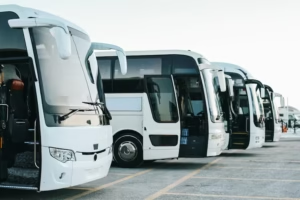
Choose a charter bus if you need precise timing, private group space, direct pickup and drop-off, multiple stops, or better control over the day. That is why many planners for weddings, schools, corporate events, and private outings lean toward charter service. It is less about novelty and more about execution.
The best transportation choice is the one that protects your schedule and makes the day easier to manage. If your trip has real stakes, and most group trips do, convenience alone is not enough. You want the option that gives you the fewest surprises and the most confidence when the wheels start moving.