
When a corporate event starts late, transportation is often the reason. A keynote waits on speakers stuck between the airport and the hotel. A dinner reception starts with half the room missing because rideshare arrivals came in waves. Staff end up answering the same text over and over – Where is the shuttle?
That is why a corporate shuttle service for events is not just a transportation line item. It is part of the event schedule itself. When it is planned correctly, guests arrive on time, check-in moves faster, and organizers spend less time fixing avoidable problems.
Why corporate shuttle service for events matters more than planners expect
Corporate events run on timing. Registration windows, meeting starts, breakout sessions, venue load-ins, sponsor obligations, and airport departures all depend on people moving when they are supposed to move. If transportation is inconsistent, the rest of the agenda starts slipping.
A dedicated shuttle plan gives event organizers more control than relying on personal vehicles or rideshare apps. That control matters most when there are groups arriving from different hotels, VIPs with tighter schedules, or venues with limited parking. It also matters when the event reflects directly on your company. Late arrivals and unclear pickup instructions do not feel minor when clients, executives, or candidates are involved.
There is also a guest experience factor. People remember whether an event felt organized. Clean vehicles, professional chauffeurs, clear pickup locations, and on-time departures reduce friction at every stage of the day. For internal events, that helps employees stay focused. For external events, it protects your brand.
When a corporate shuttle service makes the biggest difference
Not every business event needs dedicated transportation. If ten local attendees are driving to a single office meeting, a shuttle may be unnecessary. But once the event gets more complex, group transportation quickly becomes the safer choice.
It is especially useful for conferences with hotel blocks, leadership retreats with off-site activities, company celebrations with alcohol service, multi-venue meetings, trade shows, recruiting events, and airport transfers tied to a fixed agenda. In these cases, transportation is not simply about getting from point A to point B. It is about keeping dozens or hundreds of people moving on a shared schedule.
The need becomes even clearer when attendees are unfamiliar with the area. A group flying into Boston for a meeting in Cambridge does not want to navigate rental cars, parking fees, and staggered arrivals. A shuttle program keeps the day predictable and gives planners a cleaner operational picture.
The real planning decisions behind a smooth event shuttle program
Most event transportation issues start before the first vehicle arrives. The common mistake is booking by guesswork – one bus, one loop, one rough pickup time – without mapping the actual attendee flow.
A better approach starts with a few practical questions. How many people need transportation, and at what times? Are they all moving together, or in waves? Is this a hotel-to-venue loop, an airport transfer schedule, or a multi-stop itinerary? Do you need one large motorcoach, several minibuses, or a mix of vehicles for VIPs and general attendees?
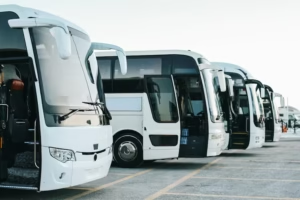
Vehicle selection should match the movement pattern, not just the total headcount. A 56-passenger motorcoach works well for moving a full group on one schedule. A minibus may be better for repeated hotel loops with smaller loads. Executive sedans or SUVs make sense for speakers, executives, or clients who need direct service. If your event has several transportation needs at once, a mixed fleet often gives better results than forcing every trip into the same vehicle type.
Timing also needs more buffer than many planners expect. Airport pickups can shift. Session end times can run long. Guests do not all board instantly. Building realistic transition windows into the itinerary helps avoid a chain reaction of delays.
What to ask before booking a corporate shuttle service for events
A strong transportation partner should make the logistics easier, not more complicated. Before confirming service, planners should understand exactly how the trip will be managed.
Start with the basics. Ask how the company builds the schedule, how driver dispatch is handled, and what support is available if there is a last-minute change. Confirm the vehicle type, passenger capacity, luggage considerations, pickup instructions, and whether the quote reflects the full itinerary.
It is also worth asking who the service is really designed for. Some providers are built for simple point-to-point moves. Others are equipped for event transportation with multiple manifests, venue coordination, and changing timelines. That difference shows up quickly on event day.
Safety and professionalism should be treated as non-negotiables. Clean vehicles, vetted chauffeurs, and consistent communication are not premium extras. They are the minimum standard for corporate travel.
Common mistakes that create avoidable event delays
Transportation problems rarely come from one dramatic failure. More often, they come from small planning gaps.
One of the biggest is underestimating boarding time. Even when attendees are ready, loading a group takes longer than expected, especially if name verification, luggage, or accessibility needs are involved. Another issue is using a single pickup time for guests staying at different hotels with different traffic patterns. That can leave one group early and another late.
Venue access is another detail planners sometimes miss. Some hotels, convention centers, and private venues have specific bus loading zones, restricted arrival windows, or circulation limits for larger vehicles. If that is not confirmed in advance, the day starts with confusion.
Communication is just as important as routing. Guests need clear instructions on where to stand, what vehicle to look for, and whom to contact if plans change. A well-run shuttle program feels simple to attendees because the operational details were handled ahead of time.
Matching the vehicle to the event experience
The right shuttle setup should support both logistics and presentation. For high-level executive events, the transportation experience may need to feel more private and polished. For conferences, capacity and timing may matter most. For company celebrations, safe return transportation can be the top priority.
That is why fleet flexibility matters. Motorcoaches are ideal for larger group movements and longer regional transfers. Minibuses are often the best fit for hotel shuttles and short-distance venue rotations. Mercedes Sprinters work well for smaller teams or VIP groups, while executive sedans and SUVs are useful when individual timing matters.
A transportation plan does not need to be flashy. It needs to fit the event. The right recommendation often comes from a provider willing to ask operational questions instead of pushing one standard vehicle for every trip.
Why regional experience matters in New England event planning
Corporate transportation in New England can look straightforward on paper and become complicated quickly. Urban pickups, older venue layouts, seasonal traffic, airport coordination, and city-to-city routing all affect timing.
That is where local operating experience adds value. A company familiar with regional event patterns can better anticipate loading restrictions, realistic drive times, and the difference between a route that works in theory and one that works on a live event schedule. For planners managing meetings across Boston, Cambridge, Rhode Island, or New Hampshire, that experience can reduce uncertainty before the day begins.
For companies that need both local and longer-distance service, it also helps to work with a provider that can support a broader itinerary instead of treating each leg as a separate problem.
What a dependable shuttle partner should deliver
At the planning stage, the right transportation company should help you narrow decisions quickly. You should get a clear quote, a vehicle recommendation based on actual group size and schedule, and a straightforward booking process. On the service side, you should expect punctual arrivals, professional chauffeurs, clean vehicles, and responsive support if your itinerary changes.
That level of consistency is what turns transportation from a risk into one less thing to worry about. Charter a Coach is built around that standard, with vehicle options for everything from executive pickups to full-scale event shuttles and 24/7 support for time-sensitive travel planning.
The best corporate shuttle programs are rarely the most complicated. They are the ones planned with realistic timing, the right vehicles, and a transportation team that understands the event matters as much as the route. If your schedule depends on people arriving together, leaving safely, and staying on track, transportation deserves the same attention as the venue and agenda.
A good event shuttle should feel almost invisible to your guests. They should simply get where they need to be, on time, without stress. That kind of reliability is what keeps your event moving and your team in control.