
A field trip can go off schedule for plenty of reasons. Transportation should not be one of them.
For school administrators, athletic directors, department coordinators, and parent group organizers, the real question is not simply whether a bus is available. It is whether the operator can meet the safety standard your students, staff, and families expect. That means looking beyond price and capacity and focusing on the school trip charter bus safety requirements that actually affect the trip.
What school trip charter bus safety requirements really cover
At a practical level, safety requirements fall into three areas: the driver, the vehicle, and the trip plan itself. A clean coach and a polished quote matter, but they do not replace documented operating standards.
For schools, that usually means confirming the charter company uses properly licensed commercial drivers, maintains vehicles on a documented service schedule, carries the right insurance, and has dispatch support in place throughout the trip. It also means making sure the itinerary is realistic. Even the safest vehicle on the road becomes a problem if pickup windows are rushed, driver hours are ignored, or supervision details are left vague.
That is why transportation decisions for student groups should be treated as risk management, not just trip logistics.
Start with the carrier, not the coach
A common mistake is choosing transportation based on bus photos, onboard amenities, or the lowest quote. Those details matter after the basics are covered. First, schools should evaluate the operator behind the vehicle.
A reputable charter provider should be able to explain how drivers are screened, how vehicles are maintained, and who supports the trip if plans change. If your group is traveling early in the morning, returning late, or crossing state lines, that operational depth matters even more. School travel often has tighter expectations than private group travel because there are minors involved, stricter supervision protocols, and less tolerance for delays.
When reviewing a company, ask direct questions. Are drivers commercially licensed and vetted? Are pre-trip inspections part of the routine? Is there a dispatch team available during the trip? How are weather issues handled? A dependable operator should answer clearly and without hesitation.
Driver standards are one of the most important safety checks
If you strip away everything else, driver quality is still the biggest factor in a safe school charter. The bus can be modern and well-equipped, but the person behind the wheel determines how the trip is executed.
Schools should expect a professional commercial driver with the correct licensing for the vehicle being operated. That includes the training required for passenger transportation and the experience to handle student groups, school schedules, and venue coordination. Background screening and motor vehicle record checks should be part of the company’s hiring and retention process.
There is also a practical side to driver safety that planners sometimes overlook: trip timing. A driver should have enough legal and realistic operating time to complete the route safely. If an itinerary is packed too tightly, the pressure shows up on the road and at every stop. A quality charter company will push back on unrealistic schedules rather than promise something it cannot deliver responsibly.
For multi-stop academic trips, athletic tournaments, or overnight travel, it may be appropriate to discuss route planning in detail, including rest timing, parking access, and return windows. That kind of conversation is a good sign. It shows the company is thinking operationally, not just selling a vehicle.
Vehicle condition matters more than onboard extras
Schools often ask about seat belts, air conditioning, Wi-Fi, and luggage space. Those are fair questions, but they should come after maintenance and inspection standards.
A safe charter bus should be routinely serviced, cleaned, and inspected before departure. Tires, brakes, lights, emergency equipment, and entry points all need to be part of that process. The same goes for interior condition. Cleanliness is not just about presentation. A well-kept cabin usually reflects a stronger maintenance culture overall.
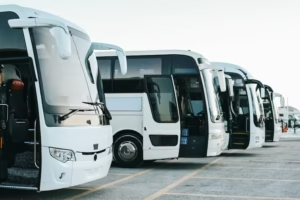
Vehicle type also matters. A full-size motorcoach may be the right fit for a large class trip or long-distance travel because it offers more storage and a more stable ride. A minibus can work well for shorter local moves or smaller student groups. The safest choice is not always the largest one. It is the vehicle that matches the group size, route, luggage needs, and trip length without crowding passengers or forcing a poor fit.
If your students are carrying instruments, athletic gear, science fair materials, or overnight bags, mention that upfront. Safe loading and proper storage are part of planning, not an afterthought on departure day.
Supervision and school policies still matter on a charter bus
One of the biggest misunderstandings around school trip charter bus safety requirements is assuming the transportation company controls every aspect of safety once students board. That is not how school travel works.
The charter company is responsible for safe vehicle operation and professional transportation service. The school is still responsible for student supervision, behavior expectations, attendance procedures, and emergency communication protocols. The strongest trips happen when both sides are clear on those roles before the bus arrives.
That means schools should assign lead staff or chaperones, keep updated passenger counts, and establish simple boarding procedures. Who checks attendance before departure? Who handles a student issue during loading? Who communicates schedule changes to the driver? Small details prevent confusion, especially on museum trips, campus visits, and event-day transportation where stops can move quickly.
It also helps to share school-specific rules in advance. If food is restricted onboard, if certain seating arrangements are required, or if there are medical or accessibility needs, the transportation provider should know before trip day.
Route planning is a safety issue, not just a scheduling issue
A route that looks fine on paper can create problems in real time. Tight pickup zones, urban loading restrictions, school dismissal traffic, venue access rules, and weather conditions all affect safety.
This is where experienced charter coordination makes a difference. A good operator will ask where the bus can safely stage, whether the destination allows coach access, and how long loading will realistically take. That is especially relevant in dense pickup areas or older city layouts, including parts of Boston and Cambridge where curb space and motorcoach access can be limited.
For school planners, the best move is to provide a complete itinerary early and be honest about constraints. If your return time is tied to a performance, a game, or a campus event release, say so. If there are young passengers who need closer supervision at rest stops, mention that too. The more accurate the trip details, the safer and smoother the operation.
Communication is part of the safety standard
A school trip should never feel unsupported once the bus leaves campus. Reliable communication matters before, during, and after departure.
Schools should know who to contact if a pickup location changes, weather affects timing, or a venue shifts its loading instructions. That is why live dispatch support matters. A charter company with real operational coverage can adjust timing, relay updates, and help keep the trip on track without forcing school staff to solve transportation problems on the fly.
This is especially important for early departures, late returns, and multi-day travel. Issues do not always happen during standard office hours. A provider with around-the-clock support is better positioned to respond when plans change unexpectedly.
What to ask before you book
The most useful screening questions are usually the simplest ones. Ask how drivers are qualified and vetted. Ask how vehicle inspections and maintenance are handled. Ask who monitors the trip and supports schedule changes. Ask whether the proposed vehicle truly fits your passenger count and equipment needs.
You should also ask how far in advance the company wants final itinerary details and passenger estimates. Last-minute changes happen, but strong planning usually leads to stronger execution. If a provider is vague on safety processes or overly focused on getting a deposit before answering operational questions, that is worth noticing.
On the other hand, a transportation partner that talks clearly about timing, routing, driver standards, vehicle matching, and support structure is usually showing you how the trip will be managed in practice.
For schools that need regional travel support, Charter a Coach works with planned itineraries across New England and keeps the process straightforward with clear quotes, vetted drivers, and trip-focused coordination at https://charteracoach.com.
The right standard is preparedness
The safest school trip is rarely the one with the flashiest bus or the fastest quote. It is the one backed by a qualified driver, a properly maintained vehicle, a realistic itinerary, and a plan that accounts for the details schools cannot afford to leave loose.
When transportation is handled with that level of care, students notice the comfort, staff notice the organization, and planners get what they need most: a trip that runs on time and feels under control.